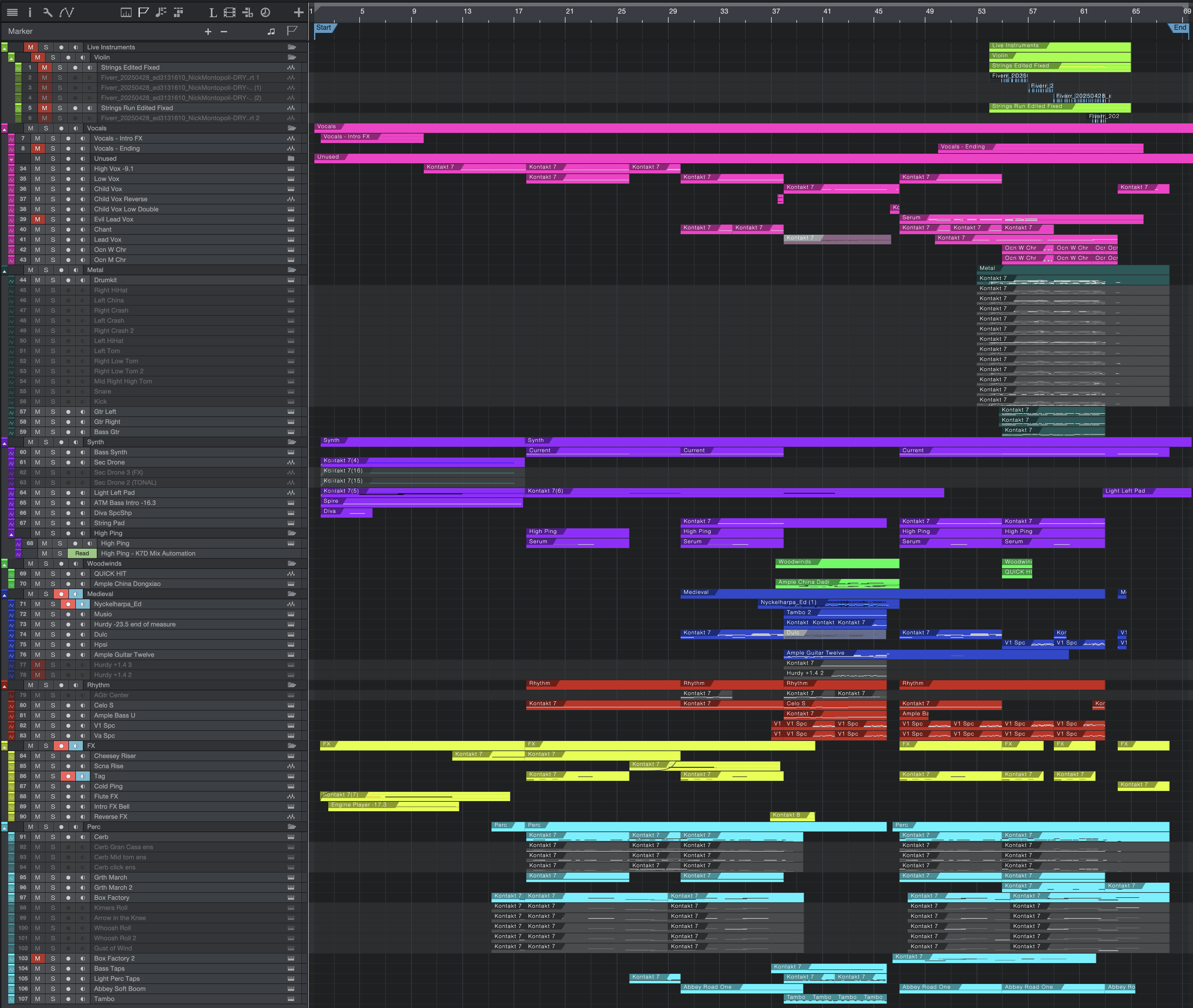
Tribal drums, demonic chants, ethnic instruments, and a metal finale. Here's how it all came together.
Song Structure
Ritual ChantCultists summon
BuildLayers stack
HeroesFalse hope
"God"
Goddess ReturnsMetal erupts
SilenceAftermath
New Libraries, New Direction
This one started, because I'd just picked up Groth by Wavelet Audio and Rotor Cello by Westwood Instruments, and I wanted to put them to work. Groth had this raw, primal energy to it, that immediately got me thinking about something tribal, almost Viking-ish in a way. Big drums, ethnic instruments, and writing in a way where things felt more like a chant than a traditional melody. Rotor Cello was a different energy, more rhythmic, close-mic'd, with this aggressive intensity to it that I knew I could put to good use.
I also wanted to try something a little different. My tracks generally end up pretty thick and layered, as I tend to fill up every bit of sonic space that I can. It creates this massive wall of sound that I'm quite fond of. But, for this one, I decided to pull back and leave a bit more room to breathe. The track has a signature tagelharpa loop from Groth and some heavy tribal percussion, and I knew that if I just opened up that space a bit for them, those elements could really shine through. I think it depends on the type of track you're going for, and honestly, I'm probably still a bit preferential towards that massive wall of sound approach, but selectively choosing when to be sparse and when to be layered is definitely something I want to keep experimenting with going forward.
Crafting the Intro
I wanted the intro to feel ghostly and atmospheric, as the song actually is about the summoning of a long forgotten evil goddess. To create that ritualistic and ethereal vibe, I'm usually looking for sounds that evolve and shift as they're held out, and then I'll use reverb or some delay to really push it into the more atmospheric realm. The goal is to set a mood before anything really "starts."
Psamathes had actually provided some extra vocal phrases beyond what was needed for the main sections, and one of them was really haunting. I felt it fit the vibe of the intro perfectly, so I threw some Quantum 2772 Evolution on it (one of the most underrated blackhole style verbs, in my opinion) and ran it through Chroma to push it even further into that otherworldly space. Alongside that, I found a drone patch in Secunda that had this ritualistic throat singing baked into it. Drone patches in libraries like this tend to work great in sparse intros, where they can be held out for a long time and really be allowed to evolve. You can hear all their little intricacies when there's not much else going on.
Panned a bit to the left, there's this windy pad that I use in almost everything at this point. It's called "Pad 1" (a very descriptive name) and surprisingly, it's actually from a piano library by Herman Samples called Frozen Piano. It's kind of funny, I originally bought that library for the piano, but I ended up using the pad way more. It's become a real staple for me and it's even made its way into my template.
The rest of the intro is rounded out with a low bass drone from a Spire preset called "Dark," which I ran through Pitch Drift by Baby Audio to give it more of that morphing, shifting type of quality. There's also a drone from Era II called "Bells of Doom". That library actually has some fantastically made atmospheric patches in it. Then, I added in a wooden flute FX, to lean into the ethnic side of things, and if you listen closely, there's even this bubbling, almost spaceship-like sound that peaks in and out during the intro, which is Diva doing its thing.
Intro Layer Breakdown
Psamathes VocalVerb + Delay + Chroma
Secunda DroneThroat singing
Frozen Piano "Pad 1"Windy texture
Spire "Dark"Bass drone + Pitch Drift
Era II Bells of DoomAtmospheric drone
Wooden Flute FXEthnic accent
DivaBubbling / spaceship-like texture
All these different layers and techniques working together, is what gives the intro that ghostly, unsettling vibe. The key thing when writing something like this, is you don't want it to feel like one note held out for thirty seconds, even though that's basically what it is. It needs to have some sort of constant motion to keep the listener engaged. Plugins are an obvious choice for this, but also picking the right sound source matters quite a bit. Subtle things like, the way the vibrato naturally shifts or the way a bowed note changes over its duration, can make a big difference in the end result. Now that all the baseline movement is established, that's when the chant kicks in.
"Goddess Tsutumina."
What the chant sounded like it was saying
The Chant That Named the Song
For the chant, I went with Fever Dreams by Fever Audio. It's got a bunch of tempo-synced phrases you can work with, and after messing around with a few of them, I landed on one that, after listening to it on repeat for a while, kind of sounded like it was saying "Goddess Tsutumina."
That totally changed the direction of the track. What had been a pretty loose tribal vibe suddenly had a story behind it. I started building around the idea that this was about a group of cultists performing a ritual to summon their long-dead evil goddess, Tsutumina. Having that narrative gave me something concrete to write towards, and it shaped pretty much every decision I made from that point on.
There are actually two layers to the chant. The higher one has this almost robotic quality to it, which comes from running it through Humanoid by Baby Audio. That plugin does a combination of extremely hard vocal tuning and voice resynthesis. When you crank the tuning that far, it stops sounding real, which is exactly the point, that's how you get the other-dimensional, eerie, unnatural vibe. The resynthesis on top of that just adds to that feeling even more. The lower, more demonic-sounding layer is Manipulator by Polyverse Music, pulling the pitch down and warping the formant. The two lines sit on top of each other. You've got this inhuman precision on top with the deep, ominous, guttural weight underneath and it fits the whole summoning mood a lot better than the raw vocals did by themselves.
Once the tribal drums kick in, there's a signature sound right at the start of each repeat. That sound is a tagelharpa loop from Groth. I like adding interesting FX-style elements like that on repeats as a way to break up the monotony and make things feel like they're progressing, even when the underlying music is still relatively stable.
As for the drums themselves, it's really just about finding the right sounds. There's no secret to it, you just try a bunch and see what works. In my experience, drums that sound fantastic in one track can sound terrible in another, so having access to a variety of different libraries is pretty important. Sometimes you want big, roomy drums with a bunch of clack, other times you want something crunchy and in your face. It just depends on the song really.
For this one, I settled on a combination of Cerberus from Audio Imperia, a marching patch from Groth, Box Factory for FX hits, Strikeforce layered on top to accent important hits, and the Soft Boom from AROOF to add a bit of extra bass where appropriate. AROOF is one of those libraries that actually really surprised me. Just given the fact that it's got so much quantity, you'd assume perhaps it might be lacking in quality, but it's actually got some really nicely recorded percussion patches. Personally, I think some of the instruments in AROOF sound better than the ones in the more expensive ARO Low Percussion or ARO Metals libraries. The Piatti and Anvil, for example, just sound better in my opinion, and AROOF also has the Soft Boom and Verdi Drums, which are phenomenal and aren't available in ARO Low Percussion. It's not as comprehensive as the full ARO libraries, but there's definitely a lot of quality in there.
For the metal section, the drums are handled by Bogren Digital's Krimh Drums, and I can't say enough good things about them. I've used a lot of metal drum sample libraries over the years, just from how much metal I've written with With Crown and Tail and other projects, and Krimh is the best I've found. They were recommended to me by Anders Orozco, an orchestral and metal composer friend of mine. I bought them on a whim based on his recommendation and haven't felt the need to look for anything else ever since.
Building the Instrumentation
Once the chant was in place, everything else just built around it.
Probably the most recognizable part of the track is the Rotor Cello pattern. It's this repetitive, in your face rhythmic line that keeps you hooked on the groove for the entire track. I panned it hard left and right, the same way you'd pan rhythm guitars in a metal mix, and since it's close mic'd, it's got this raw, abrasive quality to it. It just keeps pushing the track forward, this constant momentum that makes it feel like the ritual can't be stopped once it's been started.
LR
Drag the bars apartCenter
There's also an evil sounding bell-like melody that plays throughout the track. This is carried by the Dulciano, which is basically a grand piano played like a dulcimer, by striking the piano strings with a dulcimer hammer. I love this thing. It cuts through a mix fantastically, and because it's actually a piano, the range is way bigger than a typical dulcimer. In this track, it's got this piercing, almost bell-like tone, which makes it feel like it's heralding the arrival of the goddess every time it plays. Side note: the Dulciano is also really good for layering with string ostinatos. It brightens them up and adds a bit of percussiveness that helps them cut through. I didn't do that in this particular track, but it's a technique I use quite a lot. I've also heard Blakus do this in some of his tracks as well.
Then underneath all of that, Secunda by Wavelet Audio brings in these resonating throat-singing drones. Throat singing adds this tribalness that you just can't get from normal singing. It really helped ground the whole thing and make it feel much more ominous.
Rotor Cello
Rhythmic Drive (Full Track)
Dulciano
Evil Melody
Fever Dreams
Chant / Vocal
Secunda
Throat Singing
Tagelharpa
Signature Loop
Manipulator
Demonic Vocal FX
The Heroes' Interlude
There's a section in the middle where things shift a bit. The nyckelharpa and hurdy gurdy come in alongisde the dongxiao, and the mood picks up. The whole passage has this jovial, almost tavern-like musical quality to it, like something you'd hear in an inn in a fantasy RPG. This part is meant to represent the heroes of the story, heading off to stop the summoning. There's an almost happy-go-lucky arrogant tone to it, like they're totally confident they'll succeed. No way they could lose, right?
That confidence matters for the ending. Because right before everything kicks in, there's this one solo chanted phrase, just "God", with nothing else playing. Total silence around it. And then the metal guitars and drums come crashing in. The idea is that this is the moment the heroes realize they were too late. The goddess is back.
In order to convey this feeling of overconfident bravado, I wanted something that felt upbeat and lively and who better to reference for that than the upbeat folk master himself, Marcus Warner. I'd actually been listening to a lot of his 2019 album Reprise, and I'd always liked how, in his track Octavia, he does these quick grace note ornaments on his woodwind lines. They give the melodies that folk, happy-go-lucky, tavern-inspired flavor. I tried working some of that into the writing of the dongxiao, but also into the hurdy gurdy and nyckelharpa lines as well. Everything together gives that cheerful and optimistic sentiment I was going for.
There's also a softly played string ostinato running through the heroes' section that most people probably won't notice on a first listen. That's intentional. The idea is that the goddess is steadily building behind the scenes the whole time the heroes are on their journey. It isn't until the metal section hits, and the goddess has risen, that the ostinato really starts playing with intensity.
The Goddess Returns
Unfortunately for our heroes, their efforts are in vain, as they arrive too late. This final section has everything at full force. Metal guitars through EVA Instruments' Power Riffer, a 5-string bass guitar from SubMission Audio's Eurobass III, and Krimh Drums driving the whole thing forward. The metal isn't just an extra layer here, it is the goddess arriving. The sudden genre shift makes you really feel like something drastic has just occurred and forces you to pay attention.
That string ostinato from the heroes' section? Now it's stepped up in intensity, layered with CineHarpsichord by Cinesamples, to add a gothic sharpness to it. Nick Montopoli's live solo violin also doubles it on top, and you can really hear it cutting through with that natural edge you only get from a real player.
On top of all that, Psamathes comes in with a backing vocal melody that gives the whole section even more weight. A choir kicks in chanting the goddess' return. A full string orchestra doubles the ostinato. Everything is going all at once.
Then it all drops away. The song ends quietly, just the aftermath. The lull after the battle. The world is different now. The goddess has returned.
What I Took Away From This One
Honestly, the biggest thing I got out of making this track was that pulling back on your layering can really pay off in certain scenarios. Leaving more space than I normally would, allowed key elements to shine. The drums felt thicker, the chant felt heavier, and stripping away a lot of that layering also made the metal finale hit that much harder, because the track wasn't already maxed out before it got there. It's something I want to keep experimenting with going forward, figuring out where restraint actually serves the music better than just piling more on top and when to go all in.
If you're looking for more music like this, feel free to check out my socials, and if you're looking to add an epic orchestral or hybrid trailer flair to your next project, send me a message and we'll build something epic together.